The Firefighting 5: Top Natural Compounds That Crush Inflammation
Oct 02, 2026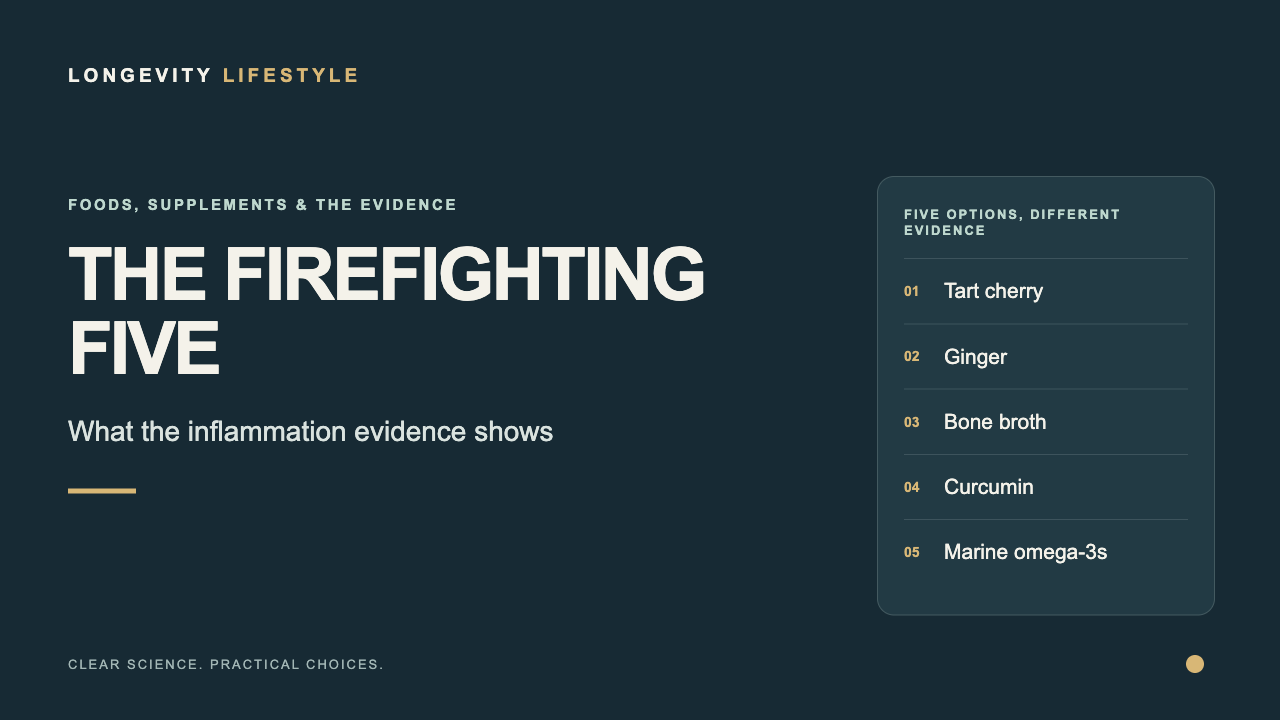
Your knee feels stiff after a hard week of training, so you search “best anti-inflammatory supplement” and land on a list that treats every ingredient like a painkiller. By the time you reach the checkout page, you’re comparing powders that haven’t even been tested for the same outcome.
Here’s my more useful version of the Firefighting Five: tart cherry, ginger, bone broth, curcumin, and marine omega-3s. They haven’t been compared head-to-head, so I can’t honestly call them the five “most potent” or rank them by strength. Some have human trials showing changes in inflammatory markers; others have much thinner evidence. A lower marker isn’t automatically less pain or better long-term health.[2][12]
Choose the one that fits your actual goal, then build it into a repeatable food pattern before buying a shelf of extracts.
This is general wellness information based on current research, not medical advice. If you have specific health concerns, please consult with a healthcare provider.
1. Tart cherry extract: promising, but mind the form
Tart cherries contain anthocyanins and other plant compounds. A review of randomized trials found a small reduction in one measure of C-reactive protein (CRP), an inflammatory marker, but not a clear effect on every inflammatory marker tested. In a six-week knee osteoarthritis trial, cherry juice changed a marker while pain improvement was not significantly better than placebo.[1][2]
That distinction matters if you’re reaching for a capsule because your joints hurt. Tart cherry extract, concentrate, and ready-to-drink juice aren’t dose-equivalent. Some trials used juice, so their results cannot be transferred to any extract sold online. Juice can also add sugar and calories. I’d treat tart cherry as an optional food or targeted experiment, not a substitute for evaluating persistent pain.
2. Ginger powder: a spice with interesting human data
Ginger contains gingerols and related compounds that can interact with inflammatory pathways. A review of randomized trials found reductions in several blood markers, including CRP, but the trial results varied substantially. A knee osteoarthritis trial used 1 gram of ginger powder daily for 12 weeks and found changes in inflammatory markers. Neither result establishes that ginger treats the underlying disease.[3][4]
Use fresh ginger or powder to make food taste good first. If you’re considering a concentrated daily dose, remember that food seasoning and a study capsule aren’t the same intervention. Ginger can cause heartburn and stomach upset, and taking medication is a good reason to check with your clinician before supplementing.[5]
3. Bone broth: useful food, weak anti-inflammatory proof
Bone broth earns a place here with an asterisk. It can be a convenient savory base for soup, and its protein and collagen content vary with the recipe and product. Reviews discuss possible effects on gut-barrier biology, but ordinary bone broth hasn’t been shown in well-controlled human trials to reduce systemic inflammation. A frequently cited experiment was in mice, not people.[6][7]
Use it when it helps you make a satisfying meal, especially with vegetables, beans, or another clear protein source. Check sodium if you need to limit it. There’s no evidence-based “anti-inflammatory cup count,” and research on standardized collagen supplements doesn't prove that a mug of broth will work the same way.
4. Curcumin: human trials, formulation questions
Curcumin is one active component in turmeric. A large randomized-trial meta-analysis found modest reductions in CRP and some other inflammatory markers across varied populations and preparations. The formulation is a real issue: ordinary turmeric in a meal, standard curcumin capsules, and products designed to increase absorption produce different exposures.[8][9]
Turmeric belongs in your cooking if you enjoy it. A concentrated curcumin supplement deserves more scrutiny than a spoonful in dinner. Some enhanced-absorption products have been linked to liver injury, according to the National Center for Complementary and Integrative Health. Check with a clinician about liver concerns, medications, or pregnancy before supplementing; don’t use curcumin to replace prescribed care.[9]
5. Marine omega-3s: food first, dose matters
EPA and DHA are omega-3 fats found in fatty fish. A review of multiple meta-analyses of omega-3 supplementation found reductions in CRP and other inflammatory markers, though results varied across populations. Even here, biomarker changes don’t guarantee relief from a particular symptom: a rheumatoid arthritis review found small, largely uncertain effects on pain and joint counts.[10][12]
Start with food if fish fits your diet. If you use a supplement, read the label for combined EPA plus DHA rather than the weight of the fish-oil capsule. There's no universal supplement dose for “inflammation.” NIH notes that 4 grams per day of omega-3 supplements taken for several years slightly increased atrial-fibrillation risk in people with cardiovascular disease or high cardiovascular risk. High doses, blood thinners, or a history of atrial fibrillation call for a clinician-guided decision.[11]
The part worth repeating
Inflammation is a normal part of repair and immune defense. When your goal is to feel and function better, check whether a specific food or supplement meaningfully changes an outcome that matters to you, alongside your sleep, training load, meals, and medical context.
If you want one starting move, try the food-first option that already fits dinner this week. Keep the bigger claims on hold until the evidence catches up.
Sources
- Tart cherry: systematic review and meta-analysis of randomized trials
- Tart cherry juice: knee osteoarthritis randomized trial
- Ginger: systematic review and meta-analysis of inflammatory markers
- Ginger powder: knee osteoarthritis randomized trial
- NCCIH: ginger safety and evidence
- Bone broth: review of gut-barrier research
- Bone broth: colitis study in mice
- Turmeric and curcumin: meta-analysis of randomized trials
- NCCIH: turmeric and curcumin safety and evidence
- Omega-3s: umbrella meta-analysis of inflammatory markers
- NIH: omega-3 fatty acids fact sheet
- Omega-3s: rheumatoid arthritis systematic review